EcoFlow Delta 3 Plus Review (2026) — Is It Worth $999?
The EcoFlow Delta 3 Plus is EcoFlow’s flagship mid-range portable power station, replacing the wildly popular Delta 2. It brings LiFePO4 battery chemistry, 2400W output, 56-minute fast charging, and expandability up to 5kWh — all in a 28 lb package that straddles the line between portable and semi-permanent installation.
Our rating: 9.1/10. The Delta 3 Plus is the most capable portable power station in the 1000Wh class. It runs more appliances, charges faster, and expands further than anything else under $1,000. The catch: at $999, it costs $350-400 more than competitors with similar capacity. Whether that premium is justified depends entirely on whether you’ll use the extra output power and expandability.
Pros and Cons
Pros:
- 2400W continuous output is the highest in any 1000Wh station — runs space heaters, induction cooktops, and power tools
- 56-minute full charge via X-Stream means you can recharge during a lunch break
- 10ms UPS switchover makes it a legitimate home backup solution
- Expandable to 5120Wh with additional battery packs — buy one now, add capacity later
- EcoFlow’s app is the best in the industry for power monitoring and remote control
- LiFePO4 battery rated for 3000+ cycles (roughly 10 years of daily use)
Cons:
- $999 MSRP is a significant premium over the Anker Solix C1000 Gen 2 ($649) and Jackery Explorer 1000 V2 ($599)
- 28 lbs is the heaviest in the 1000Wh class — six pounds more than the lightest competitor
- No IP rating despite being marketed for outdoor use — keep it dry
- Fan noise is noticeable during fast charging and heavy loads
- EcoFlow’s ecosystem can feel like a walled garden — expansion batteries only work with EcoFlow stations
Key Specs
| Spec | Delta 3 Plus |
|---|---|
| Capacity | 1024Wh |
| Output | 2400W continuous / 4800W surge |
| Weight | 28 lbs |
| Dimensions | 15.7 x 8.3 x 11.0 in |
| Battery | LiFePO4, 3000+ cycles |
| AC Charge Time | 56 minutes (X-Stream) |
| Solar Input | 500W max |
| UPS Switchover | 10ms |
| Ports | 5 AC, 4 USB (inc. USB-C 140W), 2 DC |
| Expandable | Up to 5120Wh |
| App | Yes (iOS/Android) |
| Noise | ~30dB idle, ~45dB under load |
Design and Build Quality
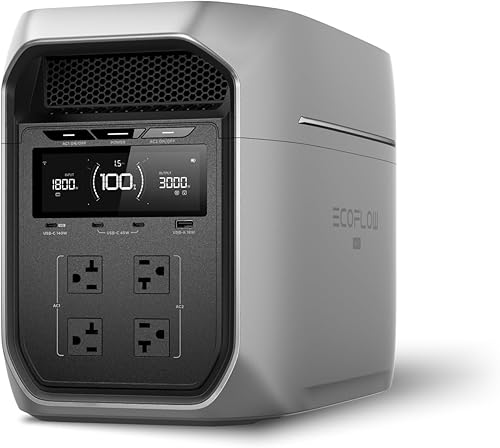
The Delta 3 Plus follows EcoFlow’s established design language — a rectangular slab with rounded edges, a sturdy top handle, and ports arranged across the front and sides. It looks and feels like a premium product. The plastic shell is thick and resilient, with rubber feet that grip surfaces well.
The front panel has a clear LCD screen showing battery percentage, input/output wattage, estimated remaining runtime, and temperature. All AC outlets are on the front with protective covers. USB ports are on the side — a minor annoyance when the station is positioned with the front facing out, since you have to reach around to plug in USB devices.
At 28 lbs, it’s heavier than both the Anker C1000 Gen 2 (25 lbs) and the Jackery Explorer 1000 V2 (22 lbs). The handle is comfortable enough for carrying short distances, but this is a station that wants to sit in one spot — your camping base, your home office, your utility shelf.
Build quality is excellent. Nothing creaks, nothing flexes, nothing feels cheap. EcoFlow has been iterating on this form factor for years and the refinement shows.
Performance
Output power is where the Delta 3 Plus separates itself from the pack. 2400W continuous means you can run appliances that would trip the overload protection on every other 1000Wh station. A 1500W space heater and a 200W fridge simultaneously? No problem — you’ve still got 700W of headroom. An 1800W induction cooktop? Handled, though it’s pushing the limits.
The 4800W surge rating handles the initial startup draw from compressor motors (fridges, AC units, power tools) that can briefly spike to 3-4x their running wattage. We tested it with a full-size fridge that draws 600W on startup and it kicked in without hesitation.
Charging speed via X-Stream is genuinely impressive. Plugging into a wall outlet, the Delta 3 Plus goes from 0% to 100% in 56 minutes. The charging curve is aggressive — it hits 80% in about 40 minutes, then tapers as the battery reaches full. The tradeoff is fan noise: during fast charging, the cooling fans are clearly audible. You wouldn’t want to fast-charge this in a bedroom at night.
Solar performance with a 500W max input is competitive. A pair of 200W panels in direct sunlight pushes about 350-380W of actual charging power (real-world efficiency is always below panel rating). Full charge from solar takes roughly 3-4 hours in good conditions. EcoFlow’s MPPT controller efficiently tracks the optimal power point, and the app shows real-time solar input so you can angle panels for maximum output.
UPS functionality works exactly as advertised. With the Delta 3 Plus plugged into a wall and your devices plugged into the station, a power cut results in a 10ms switchover — fast enough that routers don’t reset, fridges don’t skip a compressor cycle, and CPAP machines don’t interrupt therapy. This is a legitimate home backup UPS, not a gimmick.
EcoFlow App
The EcoFlow app deserves its own section because it’s genuinely a differentiator. On the home screen, you see real-time input and output wattage, battery percentage, estimated remaining runtime based on current draw, and battery temperature. You can toggle individual outlet groups (AC, USB, DC) remotely, set charge and discharge limits to preserve battery health, and schedule charging for off-peak electricity hours.
The “smart watts” feature estimates how long your battery will power specific device categories, which is useful for planning during an outage. Firmware updates push through the app, and EcoFlow has been good about adding features post-purchase.
Is the app necessary? No — the station works perfectly with the physical buttons and screen. But if you appreciate data and control, EcoFlow’s app experience is the best in the category. It’s meaningfully more capable than Anker’s and Jackery’s apps.
Expandability
The Delta 3 Plus accepts EcoFlow’s extra battery packs, expanding total capacity from 1024Wh up to 5120Wh. Each expansion battery adds another 1024Wh and connects via a simple cable on the side of the station.
This is the Delta 3 Plus’s strongest argument against cheaper alternatives. Instead of buying a bigger (and much heavier) station upfront, you can start with the base unit and add capacity as your needs and budget grow. Going from a weekend camper to a week-long boondocker to a full van life setup becomes a matter of plugging in another battery, not buying a new station.
The downside: expansion batteries cost $500-700 each, and they only work with EcoFlow stations. You’re buying into an ecosystem. If you switch brands later, the expansion batteries become expensive paperweights.
Value for Money
This is where the Delta 3 Plus faces its toughest question. At $999, it costs $350 more than the Anker Solix C1000 Gen 2 ($649) and $400 more than the Jackery Explorer 1000 V2 ($599). All three stations offer approximately 1000Wh of LiFePO4 capacity.
For that premium, you get: 400W more output (2400W vs 2000W), a better app, expandability to 5kWh, and marginally faster charging (see our full EcoFlow vs Anker breakdown). You give up: Anker’s lighter weight, longer battery lifespan (4000 vs 3000 cycles), and significantly better pricing (especially on sale).
If you know you need 2400W output or expandability, the Delta 3 Plus is the only option in the 1000Wh class that delivers both. The premium is justified because no competitor matches these features. But if your needs are served by 2000W output and a fixed 1000Wh capacity, you’re paying $350-400 for features you may never use.
Who Should Buy the EcoFlow Delta 3 Plus
Buy it if:
- You run high-wattage appliances (space heaters, induction cooktops, power tools)
- You want a home backup UPS that expands over time
- The app experience and granular power monitoring matter to you
- You plan to build an off-grid system that will grow beyond 1000Wh
- You’re a van lifer or serious boondocker investing in a long-term power solution
Skip it if:
- Your power needs stay under 2000W (most camping and basic backup scenarios)
- You prioritize portability — at 28 lbs, lighter options exist
- Budget is a primary concern — the Anker C1000 Gen 2 at $449-649 gives you 90% of the experience
- You don’t plan to expand — paying for expandability you won’t use is waste
FAQ
Is the EcoFlow Delta 3 Plus better than the Delta 2?
Yes, across the board. LiFePO4 battery (vs lithium-ion), higher output (2400W vs 1800W), faster charging, 10ms UPS (vs 30ms), and a better app. The only advantage the Delta 2 retains is its lower price on the used market. If buying new, the Delta 3 Plus is the clear choice.
Can the EcoFlow Delta 3 Plus run an air conditioner?
A small 5,000 BTU window AC unit draws about 500W running with a 1200-1500W startup surge. The Delta 3 Plus handles this easily. Larger AC units (8,000-12,000 BTU) draw 900-1500W running with surges up to 3000W — the Delta 3 Plus can handle most of these but runtime will be short (1-2 hours at full draw). It’s better suited as a bridge until grid power returns rather than an all-day cooling solution.
How does the Delta 3 Plus compare to the Delta Pro 3?
The Delta Pro 3 ($2,699) is a different class of product — 4096Wh capacity, 4000W output, 114 lbs, and optional integration with your home’s electrical panel. If you need whole-home backup or massive capacity, the Delta Pro 3 is the serious investment. The Delta 3 Plus is the portable, versatile option for people who want a station they can also take camping.
Does the Delta 3 Plus work with EcoFlow solar panels?
Yes, it’s compatible with all EcoFlow portable and rigid solar panels, as well as most third-party panels with MC4 connectors. For optimal charging, pair it with EcoFlow’s 220W or 400W bifacial panels. Third-party panels work fine — just ensure they match the voltage range (11-60V) and don’t exceed 500W combined input.
Final Verdict
The EcoFlow Delta 3 Plus is the most capable portable power station in the 1000Wh class. Nothing else matches its combination of output power, expandability, app quality, and UPS performance. The price is the trade-off — at $999, you’re paying a premium that only makes sense if you’ll use the features that justify it.
Buy it if you need what only it offers. Skip it if the Anker C1000 Gen 2’s 2000W output and fixed capacity cover your needs — you’ll save $350-550 and barely notice the difference.