Anker Solix C1000 Gen 2 Review (2026) — The Best Value in Portable Power
The Anker Solix C1000 Gen 2 is what happens when a company with over a decade of consumer electronics experience decides to make the most competitive portable power station possible. At $649 MSRP — and frequently under $500 on sale — it delivers 1056Wh of LiFePO4 capacity, 49-minute charging, 2000W output, and 10ms UPS switchover. On paper, it competes with stations costing $300-400 more.
Our rating: 9.3/10. The C1000 Gen 2 is our Editor’s Choice in the 1000Wh class. It offers the fastest charging, longest battery lifespan, and best value of any power station in its class. The only stations that beat it do so in specific categories (EcoFlow’s higher output, Jackery’s lighter weight) while costing significantly more.
Pros and Cons
Pros:
- 49-minute full charge via HyperFlash — the fastest in any 1000Wh power station
- 4000-cycle LiFePO4 battery — the longest lifespan in its class, rated for 10+ years
- 25 lbs makes it the lightest in the 1000Wh class
- $649 MSRP drops to $449 regularly — unbeatable value at sale price
- 600W solar input is the highest in class for faster off-grid charging
- 10ms UPS switchover matches premium competitors
- Anker’s established customer service and 5-year warranty
Cons:
- 2000W output is capable but 400W behind EcoFlow’s 2400W — won’t simultaneously run the heaviest appliance combos
- Expansion limited to 3168Wh total (vs EcoFlow’s 5120Wh)
- App is functional but noticeably less polished than EcoFlow’s
- No IP rating — needs shelter from rain
- Fan noise during heavy loads and fast charging
Key Specs
| Spec | C1000 Gen 2 |
|---|---|
| Capacity | 1056Wh |
| Output | 2000W continuous / 3000W surge |
| Weight | 25 lbs |
| Dimensions | 14.3 x 8.2 x 10.0 in |
| Battery | LiFePO4, 4000 cycles |
| AC Charge Time | 49 minutes (HyperFlash) |
| Solar Input | 600W max |
| UPS Switchover | 10ms |
| Ports | 4 AC, 4 USB (inc. USB-C 140W), 2 DC |
| Expandable | Up to 3168Wh |
| App | Yes (iOS/Android) |
| Noise | ~30dB idle, ~42dB under load |
Design and Build Quality
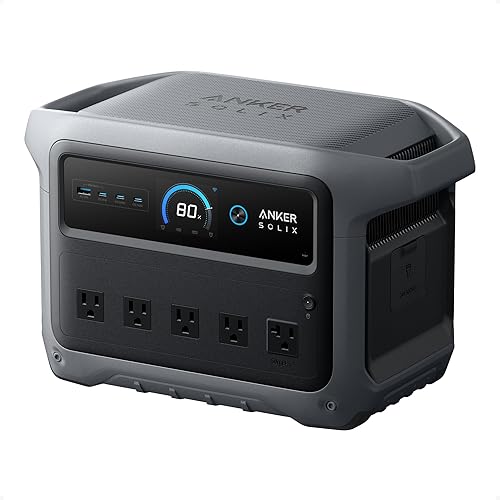
The C1000 Gen 2 is compact for its capacity. At 14.3 x 8.2 x 10.0 inches, it has a smaller footprint than both the EcoFlow Delta 3 Plus and the Jackery Explorer 1000 V2. The design is clean and utilitarian — a dark grey rectangular body with a comfortable fold-flat handle on top and ports arranged logically across the front panel.
Build quality reflects Anker’s experience manufacturing millions of consumer electronics products. Everything clicks into place, ports are solid, and the rubber feet prevent sliding on smooth surfaces. The LCD display shows battery percentage, input/output wattage, and estimated runtime — less detailed than EcoFlow’s screen but all the information you actually need at a glance.
At 25 lbs, it’s noticeably lighter than the EcoFlow Delta 3 Plus (28 lbs) while packing slightly more capacity (1056Wh vs 1024Wh). Anker clearly optimized for weight-to-capacity ratio, and it pays off when you’re loading the car or carrying it to a campsite.
Performance
Charging speed is the C1000 Gen 2’s headline feature. HyperFlash technology achieves a full 0-100% charge in 49 minutes from a standard wall outlet. That’s the fastest charging time in any 1000Wh portable power station — seven minutes faster than EcoFlow’s X-Stream and dramatically faster than Jackery’s 1.7 hours.
The practical impact is significant. Forgot to charge it last night? Plug it in while you eat breakfast and it’s full before you leave. Drained it during a power outage? It’s back to 100% before you’ve finished cleaning up. Running it at a worksite and need to recharge during lunch? Done with time to spare.
Output power at 2000W continuous handles the vast majority of real-world needs. A full-size fridge (150W running), a laptop (60W), a phone charger (20W), LED lights (30W), and a small fan (40W) together draw about 300W — leaving you 1700W of headroom. You can run a blender, a small electric griddle, or a portable heater individually with plenty of margin.
Where 2000W falls short: running a 1500W space heater AND a fridge AND other devices simultaneously. The EcoFlow’s 2400W handles that scenario; the Anker doesn’t. In practice, this limitation affects a small percentage of users in a small percentage of scenarios.
Solar charging benefits from the industry-leading 600W maximum input. With a pair of 200W panels in good sunlight, you’ll see 350-400W of actual charging power, reaching a full charge in about 3 hours. That’s roughly 20% faster than EcoFlow (500W max) and 50% faster than Jackery (400W max) for solar-dependent off-grid use.
UPS performance is flawless. The 10ms switchover keeps connected devices running without interruption during power cuts. We tested it with a router, a NAS drive, and a laptop — none dropped their connections or lost data during the switchover. This matches the best UPS performance from any portable power station, including models costing twice as much.
Battery and Longevity
The 4000-cycle LiFePO4 battery is the longest-lasting in the 1000Wh class. At one full charge/discharge cycle per day, you’d reach 4000 cycles in about 11 years. At a more typical once-per-week camping or backup use, the math becomes almost absurd — decades of useful life before meaningful degradation.
LiFePO4 chemistry also performs better in temperature extremes than standard lithium-ion. The C1000 Gen 2 charges in temperatures from 32°F to 113°F and discharges from -4°F to 113°F. For cold-weather campers, this means the battery maintains reasonable performance in conditions that would significantly degrade lithium-ion cells.
Anker recommends storing the unit at 60% charge for maximum long-term battery health, with a top-up every 3-6 months if stored unused. Standard LiFePO4 best practices.
App Experience
The Anker app (renamed from the original Solix app) provides basic but effective control. You can see battery percentage and charge/discharge rates, toggle AC, USB, and DC outlets on and off, check firmware status and install updates, and view basic usage statistics.
What it doesn’t do: real-time per-outlet wattage monitoring, detailed usage history, charge scheduling, or the granular power flow visualization that EcoFlow’s app provides. If you’ve used EcoFlow’s app, Anker’s feels sparse. If you’ve never used either, Anker’s is perfectly adequate.
For most users, the app is opened once during initial setup, once when a firmware update is available, and almost never otherwise. The physical controls and screen on the unit itself handle day-to-day use.
Value Proposition
The C1000 Gen 2’s value argument is almost unfair. At its frequent sale price of $449, you’re getting:
- More capacity than the EcoFlow Delta 3 Plus (1056Wh vs 1024Wh)
- Faster charging (49 min vs 56 min)
- Longer battery lifespan (4000 vs 3000 cycles)
- Lighter weight (25 lbs vs 28 lbs)
- Higher solar input (600W vs 500W)
- Matching UPS switchover speed (10ms)
…for $550 less than EcoFlow’s $999.
EcoFlow wins on output power (2400W vs 2000W), expandability ceiling (5120Wh vs 3168Wh), and app quality (see our full EcoFlow vs Anker comparison). Those are real advantages for the right buyer. But for the average person who needs a reliable, high-capacity portable power station for camping, home backup, or general use, the Anker delivers 90% of the top-tier experience at 45-65% of the price.
Who Should Buy the Anker Solix C1000 Gen 2
Buy it if:
- You want the best overall value in portable power stations — period
- Fast charging is important (49 minutes is unmatched)
- You care about battery longevity (4000 cycles)
- Portability matters — 25 lbs is the lightest in the 1000Wh class
- Your power needs stay at or under 2000W (covers the vast majority of use cases)
- You’re patient enough to wait for sales — $449 is an absurd amount of power station for the money
Skip it if:
- You need 2400W+ output for simultaneous heavy appliances
- You want to expand beyond 3168Wh total capacity
- App quality and data visualization are important to you
- You’re building a whole-home backup system (EcoFlow’s ecosystem goes deeper)
FAQ
How often does the Anker C1000 Gen 2 go on sale?
Roughly every 4-6 weeks. Anker runs frequent promotions on Amazon and their own site, with the biggest discounts during Prime Day, Black Friday, and Anker’s anniversary sales. The C1000 Gen 2 regularly drops to $449, occasionally hitting $399 during major events. Use CamelCamelCamel or Keepa to set a price alert.
Is the Gen 2 worth it over the original C1000?
Absolutely. The Gen 2 brings HyperFlash charging (49 min vs the original’s 1.5 hours), higher output (2000W vs 1800W), higher surge (3000W vs 2400W), and more cycles (4000 vs 3000). If the Gen 1 is deeply discounted below $350, it’s still a solid buy — but the Gen 2 improvements are significant enough to justify the price difference at normal pricing.
Can the Anker C1000 Gen 2 run a mini fridge?
Easily. A typical 12V camping fridge draws 30-60W average (with compressor cycling). The C1000 Gen 2 handles the startup surge without issues and can run a mini fridge for 15-30+ hours on a single charge depending on ambient temperature and how often you open the door.
How does the C1000 Gen 2 compare to the Anker Solix F2000?
The F2000 (PowerHouse 767) offers 2048Wh capacity and 2400W output — double the capacity and more output power. But it weighs 62 lbs and costs $1,099. The C1000 Gen 2 is the better choice for portability and value; the F2000 is for users who need maximum capacity and don’t plan to move it frequently.
Final Verdict
The Anker Solix C1000 Gen 2 is the best value portable power station on the market. It matches or beats more expensive competitors on charging speed, battery lifespan, weight, and solar input while costing hundreds less. The only areas where it concedes ground — output power and expandability — matter only to a subset of power users.
If you can only buy one portable power station and want the most capability per dollar, this is it. Wait for a sale, grab it for $449, and you’ll have a power station that handles camping, home backup, and everyday portable power needs for a decade or more.